Search This Blog

Showing posts with label Austen. Show all posts

Tuesday, 12 April 2016

The Pen Mightier Than The Pelisse?


In Jane Austen’s novel Persuasion, Anne Elliot seemingly mourns the disparity between women’s and men’s education, and women’s lack of representation in history and the arts: ‘Men have had every advantage of us in telling their own story. Education has been theirs in so much higher a degree; the pen has been in their hands’.

But in an age when society believed that a girl’s ultimate ambition should be a wife and mother, an increasing number of women (like Austen herself) took up their pens in the hope of earning some money of their own. In a letter to her brother Frank Austen in 1813, she told him of the success of Pride and Prejudice and Sense and Sensibility: ‘I have now therefore written myself into £250 –which only makes me long for more' (worth approximately £16,000 in today's money).

Over the next few blog posts, I’ll be taking a look at some of Austen’s predecessors and contemporaries who created a fresh role for themselves in society as authors. However, to avoid society's censure, like Austen, they often wrote under a cloak of anonymity. 

Frontispiece of a French edition of Persuasion, Jane Austen's 'La Famille Elliot' (1821) courtesy Wikimedia Commons. 

Wednesday, 2 March 2016

Mr Darcy Is Coming! Planning A Special Dinner


Mrs Elton with her housekeeper.

When planning a dinner or card party, hostesses set aside part of the day to organise menus with their housekeeper or cook. Emma’s new bride, Mrs Elton, complained: ‘I believe I was half an hour this morning shut up with my housekeeper.’ 
Mrs Elton and her pearls.
If only one course was served, the company was told ‘You see your dinner’ when they sat down to dine. But for a special dinner party, at least two courses were provided. When Pride and Prejudice’s Mrs Bennet invited Mr Bingley and Mr Darcy to a family dinner at Longbourn, she, ‘did not think anything less than two courses could be good enough for a man on whom she had such anxious designs, or satisfy the appetite and pride of one who had ten thousand a year.’


Perkins, 'Every Woman Her Own Housekeeper'.
All the dishes for the first course were placed on the table at the same time. Then the serving dishes were ‘removed’ for the second course, which was arranged in a similar fashion. Guests ate a little of what they fancy from the dishes closest to them, perhaps asking a servant to pass them a favourite dish, if wanted, from the far end of the table.

'The gentlemen did approach'.

Genteel hostesses dressed smartly though not over-grand, so that their guests did not feel inferior if only modestly attired; but for dinner parties, ladies and gentlemen normally wore full evening dress.
Images:
Charles Brock coloured illustrations for Emma, and black and white illustration for Pride and Prejudice, courtesy of Mollands.
A sample 3 course dinner for the month of March. John Perkins, Every Woman Her Own House-keeper, (London, 1796). Courtesy Google Books.

Tuesday, 3 February 2015

Latest Reviews of A Visitor's Guide to Jane Austen's England

I have been very busy working on a new project for the last few weeks, so I've been rather out of the loop. So I was thrilled to bits when I discovered this review on the Shields Gazette website:
'Discover the grim reality of Jane Austen’s England
In fact, the smells and tastes would probably make us sick; go far enough back, and we wouldn’t even be able to understand our own language.
So while period dramas are seductive on the telly, in reality, returning to, say, the turn of the 19th century may mean that your false teeth could have been taken from a dead soldier, face powder turns your skin brown, or even black, and surgery is carried out without anaesthetic.
Given that I’ve just had a tooth out, a Regency-era remedy for toothache – using a hot wire driven into an aching tooth to kill the nerve – makes me wince.
You would, then, need something like A Visitor’s Guide to Jane Austen’s England, which chaperones you across the social, health etc minefields of what could feel, in effect, like a foreign country.
Not that it’s even the terrain of the working man. The world Austen moved in bordered the middle/upper class, so there is the treatment of servants to consider, and how to keep up with fashion – “What wicked people dyers are” – dyeing a dress being one way of recycling your clothes.
A dance at a ball or an assembly hall is the best, approved way to meet the opposite sex. Once married, though, having separate rooms may be your only form of contraception. Jane Austen’s sister-in-law, Elizabeth, had 10 children before the age of 35, when she died in childbirth.
It all makes for an entertaining read and is charmingly illustrated with contemporary images, including the work of hilarious caricaturist Gillray'.
There's also another lovely review here on the Heritage Traveller website.

Sunday, 17 August 2014

A Georgian Gem

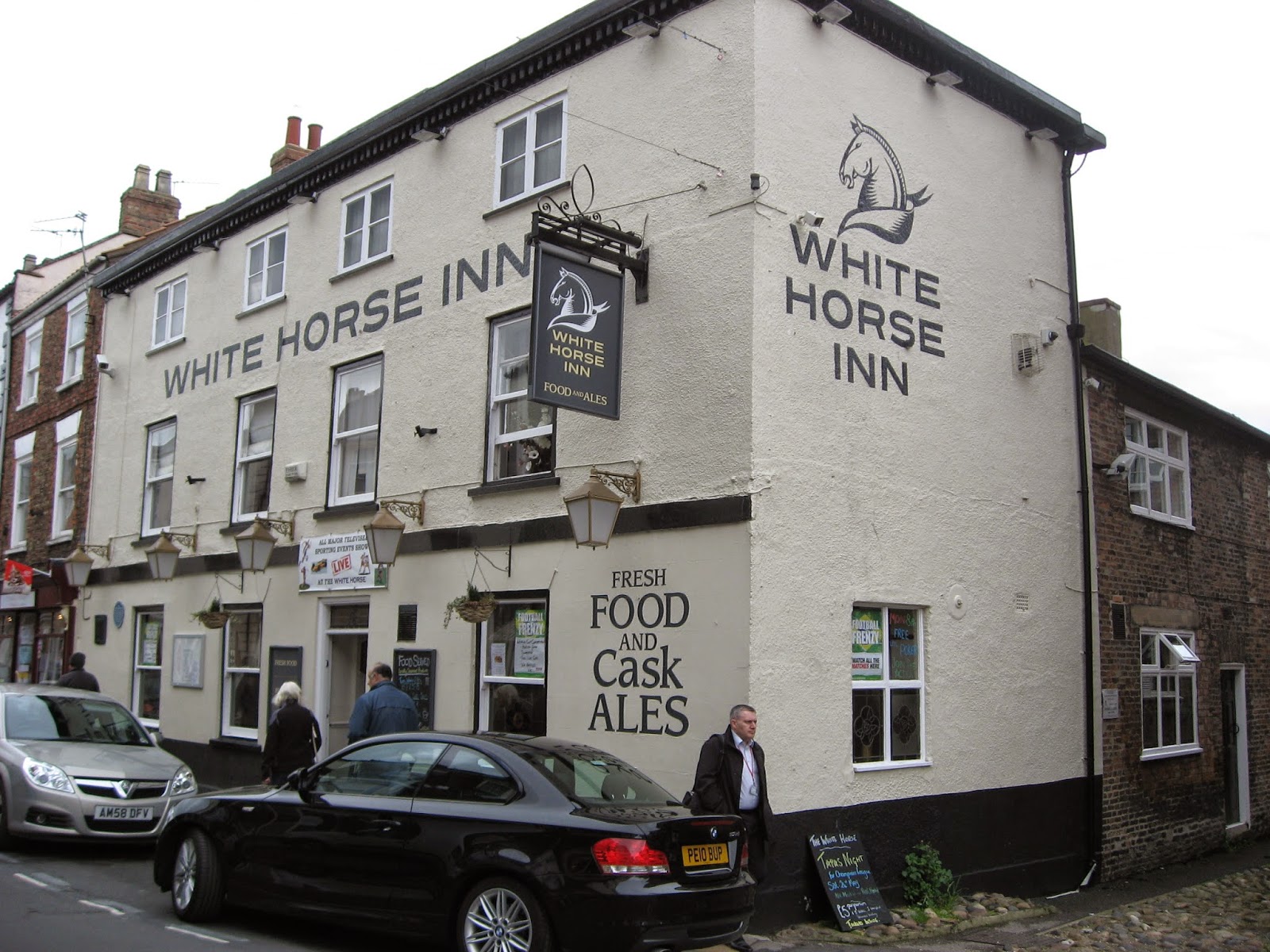
The White Horse Inn dates back to 1702.
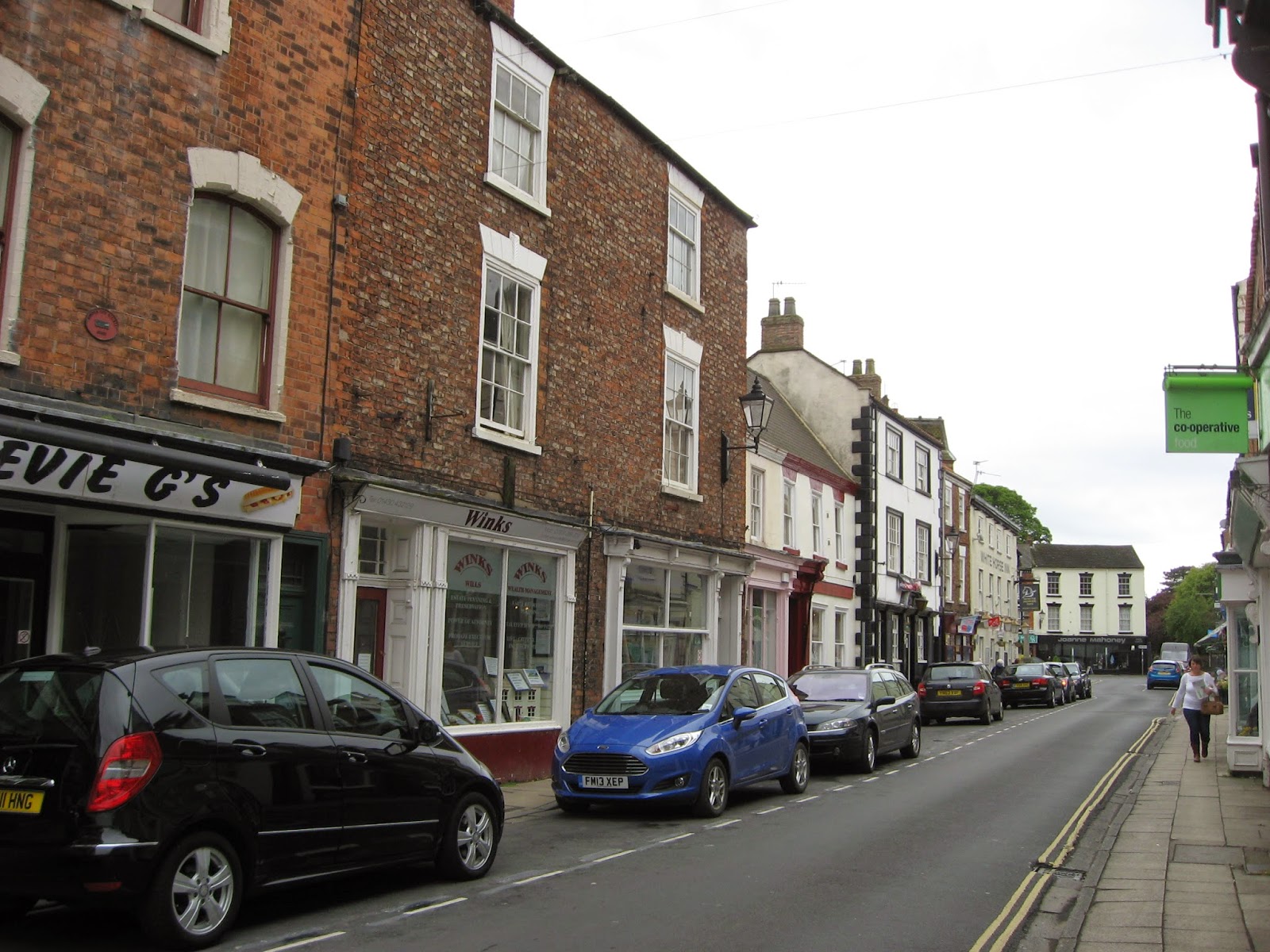
The small market town of Howden in Yorkshire is a living witness to life in Jane Austen's day.  Although Howden is famous for its medieval Minster, many eighteenth and early nineteenth century houses, shops and coaching inns have also survived.
Eighteenth century shops, Marketplace.
As you explore this bustling town you can imagine what it might have been like to go shopping in Austen's England.
Wellington Hotel, formerly the White Hart Inn.
Of course you must somehow erase the noise of the cars and buses from your mind, and imagine them replaced with the clip-clop of horses, the rattle of wheels and the blast of a coachman's horn as he sweeps into a busy innyard.                                            
Bridgegate, Howden - note arched entrance.

The former C.18th century workhouse.

Thursday, 27 March 2014

Book Launch Date

Exciting news! I've just heard that the launch date for my new book A Visitor's Guide to Jane Austen's England is planned by Pen & Sword History for the end of October 2014! I'll update this blog if there's any change. You can also follow me on Twitter @SueWilkesauthor or @austensengland for more news and updates - or visit the Pen & Sword History blog here.

Monday, 10 March 2014

A Night At The Opera


On 8 January 1801, Jane Austen wrote to her sister Cassandra, who was staying at Godmersham Park: ‘I think you judge very wisely in putting off your London visit...You speak with such noble resignation of Mrs Jordan and the Opera House, that it would be an insult to suppose resignation required’.  By 25 January, Cassandra must have written to Jane to say that she would soon be on her way to the metropolis: ‘I hope you shall see everything worthy [of] notice, from the Opera House to Henry’s [their brother’s] office in Cleveland Court; and I shall expect you to lay in a stock of intelligence that may procure me amusement for twelve months to come’ (Lord Edward Brabourne, Letters of Jane Austen, 2 Vols., Richard Bentley & Son, 1884).

Which Opera House was Jane referring to? According to A Picture of London for 1802, (R. Phillips, c.1802), the Opera House, a ‘magnificent theatre’ was ‘situated at the lower end of the west side of the Haymarket’.  It was originally known as the Queen’s Theatre, and was built by John Vanbrugh in about 1705.  The Opera House ‘was open in the winter, and till Midsummer, for Italian operas and French ballets’.

However by about 1808, Ackermann’s Microcosm of London rather snootily commented that although the stage scenery was ‘very good’, the stage was ‘not sufficient for the magnificent ballets which the prevailing taste of the day requires’. 

In 1837 the Opera House was renamed Her Majesty’s Theatre, in honour of Queen Victoria’s accession to the throne.
Images from the author’s collection:
Evening dress. The Lady’s Magazine, January 1827.
The Opera House in 1800. Old and New London Vol. IV, 1878.

Tuesday, 3 December 2013

Regency Cheshire Talk Photos

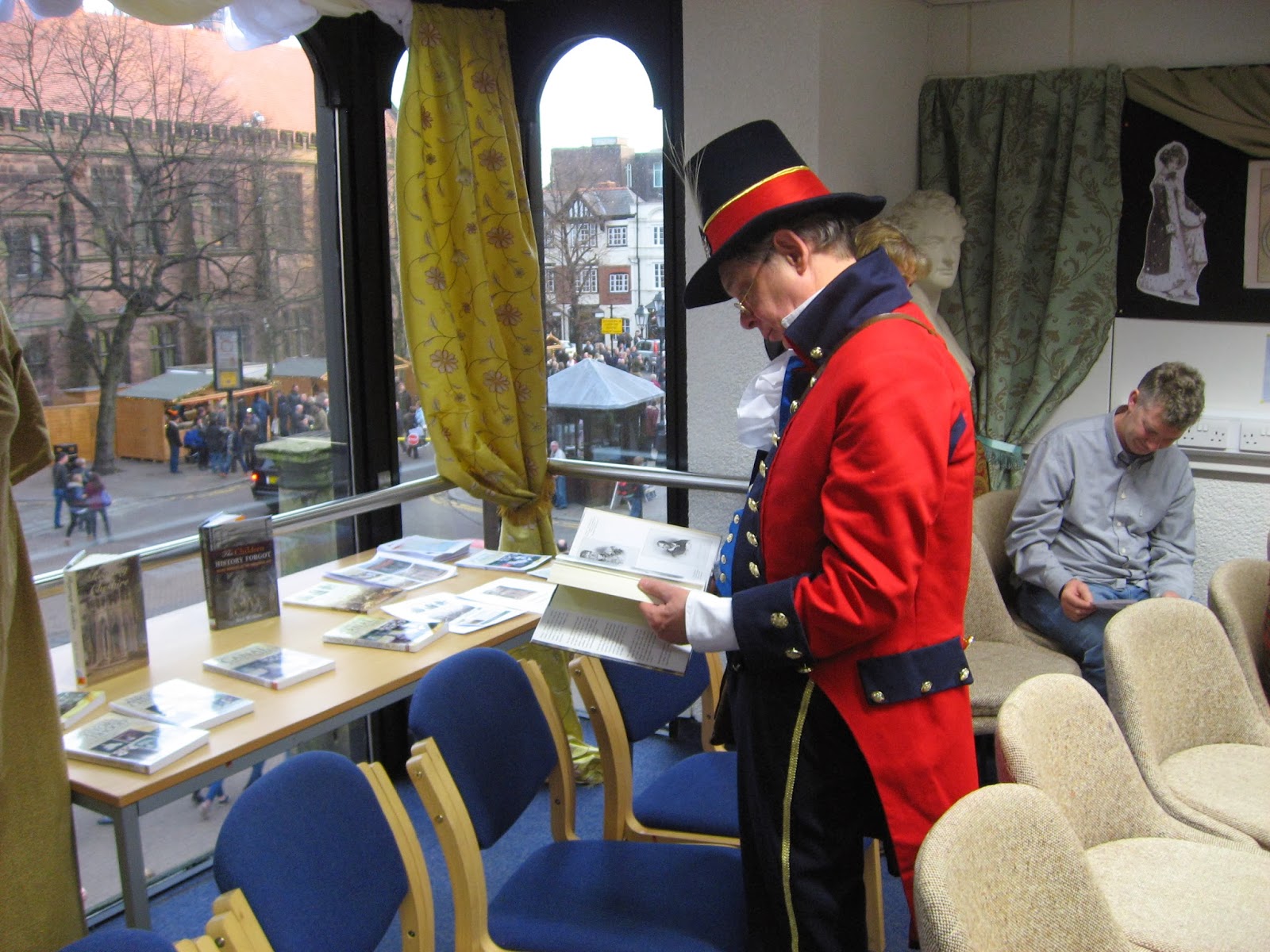
 My Regency Cheshire talk at Chester Library last Saturday was a sell-out! Many thanks to everyone who braved the Chester traffic, as the city was very busy with Christmas shoppers.
It was wonderful to see the library staff dressed up in such beautiful Regency costumes, and those members of the audience who took the trouble to come dressed Austen-era style, too.

I'd like to thank Lena Shiell, Debbie, Linda Clarke and all the library staff for making me so welcome.  The meeting room was adorned with a wonderful exhibition of Georgian prints courtesy of Chester Library, too. 
There are more photos from the event on my Sue Wilkes blog and on the Chester Library facebook page.

Images:
Chester town crier David Mitchell (top, bottom right) resplendent in his Georgian costume.  
Lena Shiell, the author (centre) and Linda Clarke.
Lena (Chester Library) and Linda Clarke (Cheshire Archives).

All photos on this blog post are © Nigel Wilkes.

Monday, 21 October 2013

Austen's Novels Revamped

News just in!
Following the recent report that Austen's Emma will be re-worked by Alexander McCall Smith, the BBC News website has just reported that all of Jane Austen's published novels will be rewritten by six modern authors and translated into a modern-day setting. Joanna Trollope's version of Sense and Sensibility will be launched imminently.

I'm not sure I approve - how do you rewrite a classic? I think Austen's novels have stood the test of time - they are still immensely popular in their own right.

Many authors, including the lovely Jane Odiwe, have created fresh novels and sequels from Austen's original novels and characters, and I personally welcome anything which popularizes Austen and her works.

But will readers think that the Austen Project is a step too far? Should Austen's novels be - do they need to be - updated for modern readers? I'd love to know what do you think?


Update 24 October: You can read views by two experts, Professor Kathryn Sutherland from the University of Oxford, and Professor Emma Clery from the University of Southampton, on the Austen rewrites here.


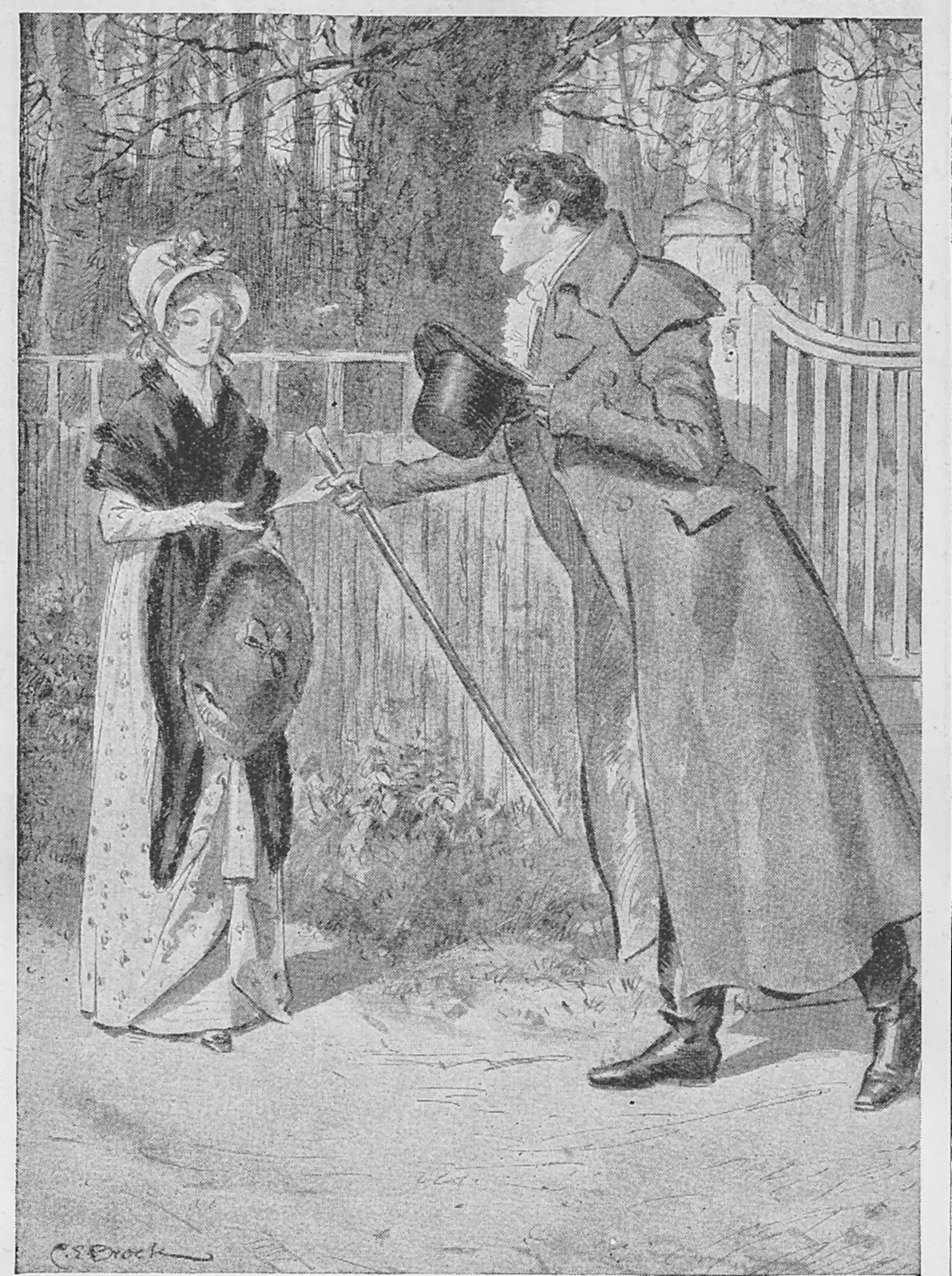
Image: 'Will you do me the honour of reading that letter?' Mr Darcy gives Elizabeth Bennet a letter in the park.  Illustration by C.E. Brock for Pride and Prejudice (Cassell’s Book of Knowledge Vol. VIII, (Waverley Book Co., c.1920)).

Wednesday, 31 July 2013

A Visit to Winchester

I've visited Winchester a couple of times before, but recently I paid my first visit to the City Mill. There's been a mill on this site since medieval times; it was rebuilt in 1744, and was in use until the twentieth century.  It has recently been restored by the National Trust, and you can watch flour being ground the traditional way. You can even buy some of the flour and have a go at making your own when you get home.  Otters play on the River Itchen, which powers the machinery, at night when the city is asleep.

We also walked past the house where Jane Austen spent her final days in 1817 (now a private residence). If you're visiting her native county of Hampshire, you might like to download a trail leaflet from here.

Images: Winchester City Mill, and the house in College St where Austen died.


© Sue Wilkes.