A new Jane Austen-inspired movie, Austenland, produced by Stephanie Meyer, will be released in the UK on 27 September. Reviews (in the US) seem to be rather mixed so far - you can read some here on the NPR site, here on the NY Times website, and here on the New York Daily News site.
And if you'd like more information on the movie, you can see a trailer, plus photos of the cast, here on the Sony Pictures Classics website.
Update 8 October: you can read Louise West's review of Austenland here.
Friday, 16 August 2013

Wednesday, 31 July 2013
A Visit to Winchester


Images: Winchester City Mill, and the house in College St where Austen died.
© Sue Wilkes.
Wednesday, 24 July 2013
Jane Austen Stars
The Bank of England has just announced that Jane Austen will replace Charles Darwin on the new £10 note, which will be issued in 2017! So if you are flush with cash, and pining for a Jane Austen fix, you'll be able to withdraw a tenner from your reticule and gaze at Jane's portrait.
Wednesday, 10 July 2013
Robert Owen

Owen was appalled by the workers' working and living conditions and wanted to help. His opportunity came when he became manager of New Lanark mills in Scotland, near the Falls of the Clyde.

Many of the workers at the mill were child parish apprentices; some were from the Edinburgh poor house and charities in the city. Owen vowed to end the use of parish apprentices when he began running New Lanark.You can find out more about Owen's amazing experiment at New Lanark, his controversial social and religious theories, and his influence on the co-operative movement in my latest feature for Jane Austen's Regency World. My book The Children History Forgot also discusses Owen's care for the workers at New Lanark, the school he founded there, and his influence on the factory reform and 'Ten Hours' movement.
Images from author's collection
Orphan School, Edinburgh, Views of Edinburgh and Its Vicinity, 1819. Children from the workhouse and charities like
this one were employed in the mills at New Lanark.
The Falls of the Clyde.
Water from the river Clyde powered the New Lanark Mills. Ladies’ Cabinet of Fashion, Music and
Romance, 1837.
Wednesday, 3 July 2013
Changing Fashions

This ‘Cabinet of Fashion’ fashion plate for the Lady's Monthly Museum, June 1805 shows a ‘Morning dress of cambric muslin with spencer cloak
of blue silk. Full dress of straw-coloured sarsenet (sic) with a tunic of rich
embroidered white crape. Hair dressed with ‘Diamonds set on Velvet, with a
profusion of White Ostrich Feathers.’

Walking dresses had acquired a more free-flowing, gentle
style by the time of this undated fashion print from the Lady’s Magazine, dated
circa 1813-1814 (right). The lady's hat is sporting a huge ostrich feather.
By 1827 waistlines had
become more distinct, and the lady in this later Lady’s Magazine print (below) is wearing an
enormous poke bonnet.
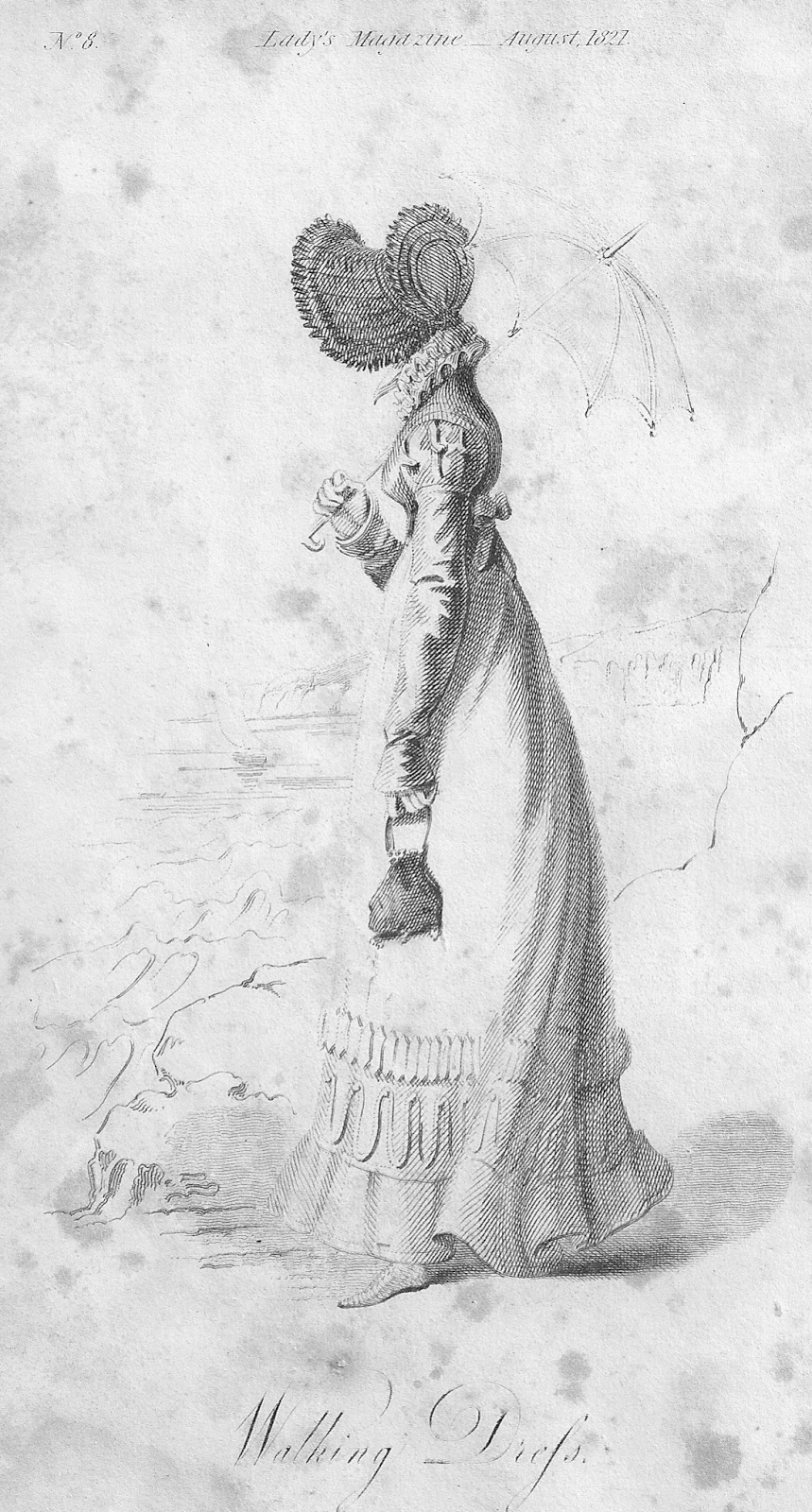
You can see some fabulous images of Regency-era fashions here on Jane Odiwe's blog, and there's more info here on the Pemberley website.
Tuesday, 2 July 2013
The Mary Hardy Diaries
Many thanks to Roy and Lesley Adkins for drawing my attention to the Mary Hardy Diaries. This Georgian lady wrote a diary for over 36 years - from 1733-1809 - so she was a contemporary of Jane Austen. Mary's apprentice Henry Raven also kept a journal! Mary lived in Norfolk, but travelled extensively. This looks like an amazing resource for historians.
Monday, 1 July 2013
A Grand Day Out
Click here for a look back at my recent visit to Jane Austen's House Museum and Chawton House Library - thoroughly recommended for all Jane Austen fans!
Subscribe to:
Posts (Atom)